

How To Draw A Simple Guitar
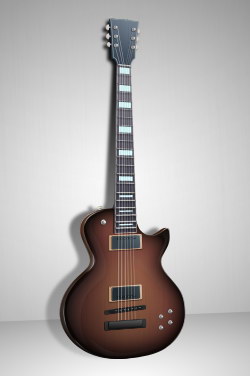
Preview
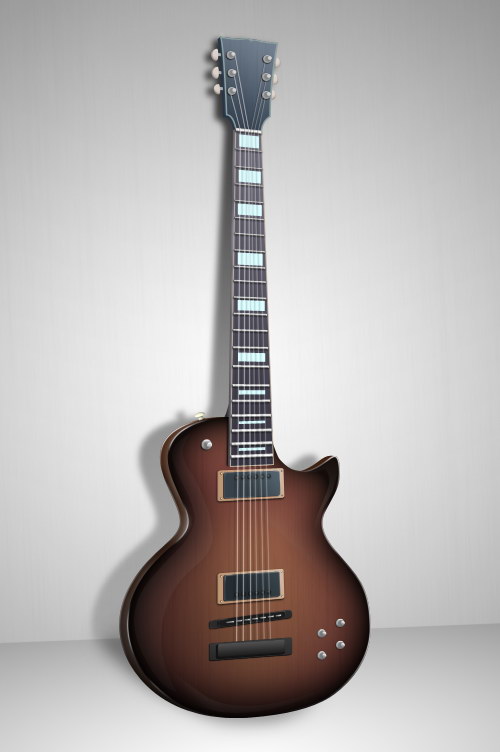
Preliminary Step: Research
As ever, we need to search for image references to go a skillful idea of what nosotros are going to draw. The electrical guitar we are going to draw is inspired by the legendary Gibson Les Paul guitar. You can find photos of it in Google Images.
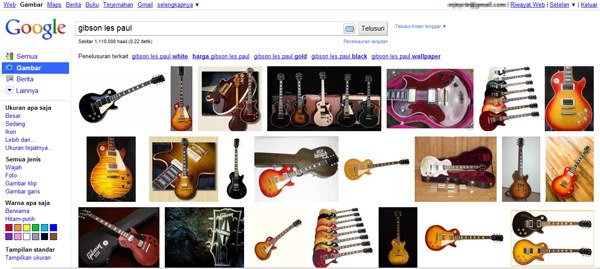
Look at some reference images to familiarize yourself with the parts of the guitar.
Step i: Describe the Guitar'due south Torso Shape
Create a new Photoshop document with a canvass size of 1000x1500px. A large sail volition assist united states of america with the drawing of the details of the electrical guitar easier.
Let's start with the basic shape.
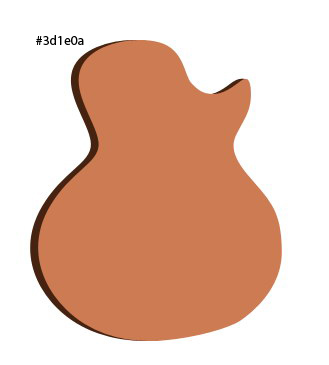
Use the Pen Tool (P) to create the body shape of the guitar using a brownish-salmon colour (#cd7b53) every bit the fill color.
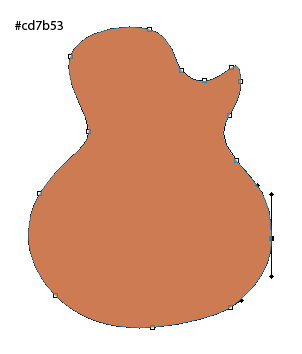
Duplicate the path and move it 15px to the left. This will represent the left side of the guitar.
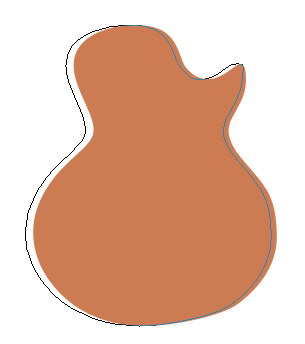
Make full the duplicate path with a brown color (#3d1e0a) that is darker than the kickoff color. Place this shape backside the original one. The combination of these two shapes volition aid develop the 3D appearance of the guitar.
Step two: Depict the Guitar's Neck
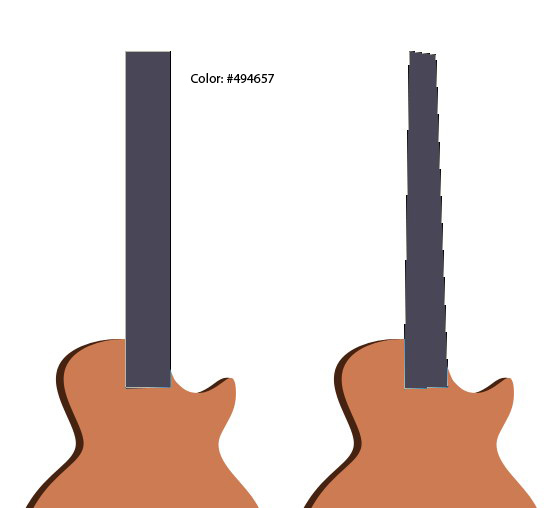
Create a rectangle shape for the guitar's neck. Remember to alter its perspective until information technology matches upwardly with the body. You can use Edit > Transform > Skew or modify its anchor points individually.
Pace iii: Draw the Headstock
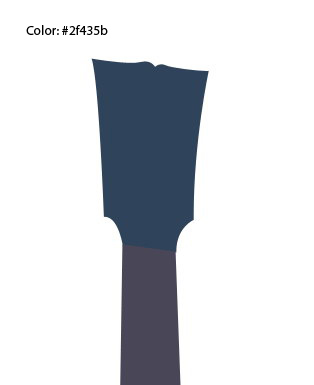
On top of the neck, use the Pen Tool (P) to draw the guitar's headstock.
Below y'all will see the basic shapes of our guitar.
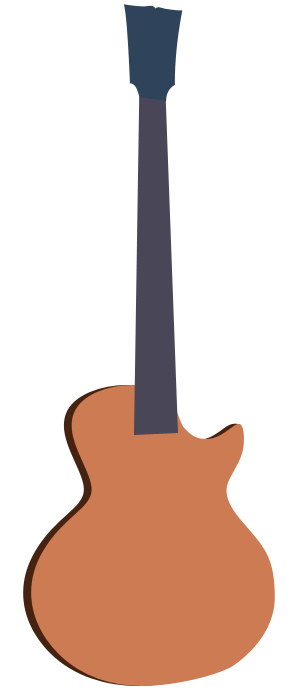
Side by side, nosotros will exist modifying the guitar parts and calculation in the guitar'south details.
Step 4: Colour the Surface of the Guitar'south Torso
Temporarily hibernate all the shapes except the guitar's trunk then that we can concentrate on it.
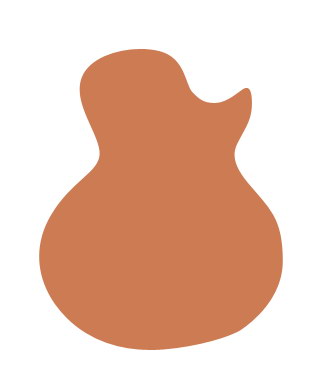
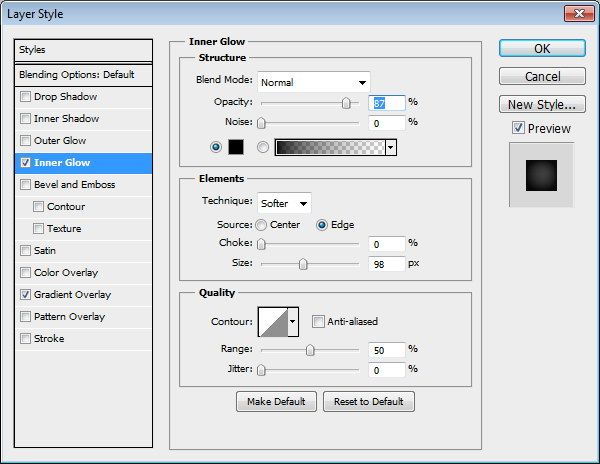
Requite the trunk an Inner Glow layer effect (to add a dark line along the edge) and a Slope Overlay layer effect (to spice up our otherwise tiresome, flat color).
Inner Glow
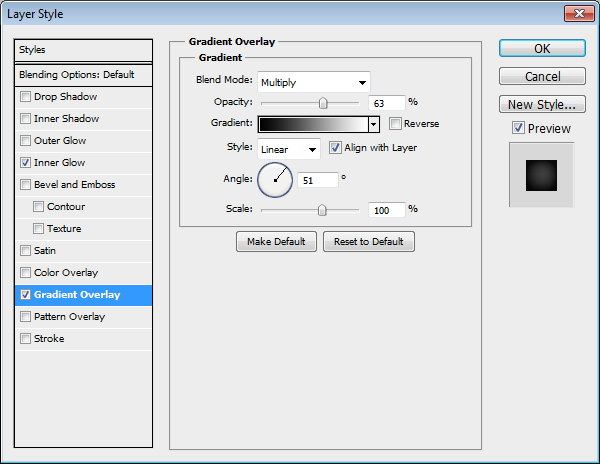
Slope Overlay
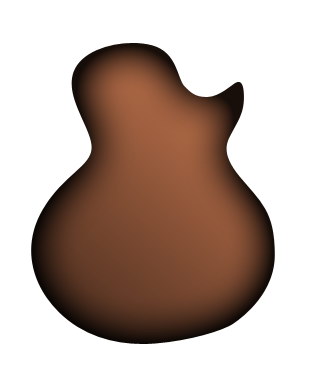
Here'due south the result of our layer style:
Create a path using the Pen Tool that cuts across the top half of the guitar's body. Hit Ctrl/Cmd + Enter to convert the path to a option.
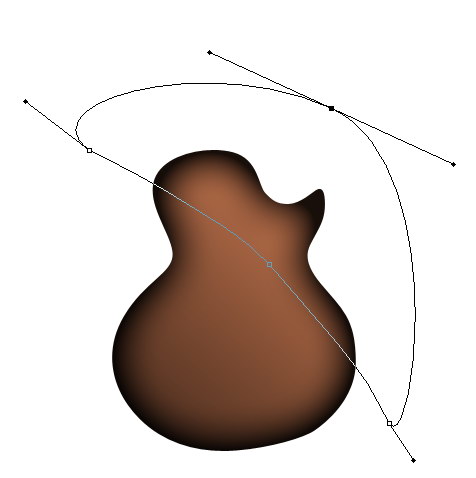
Hold down Ctrl/Cmd + Alt/Option and and so click on the body's thumbnail in the Layers Panel to intersect the option with the body shape.
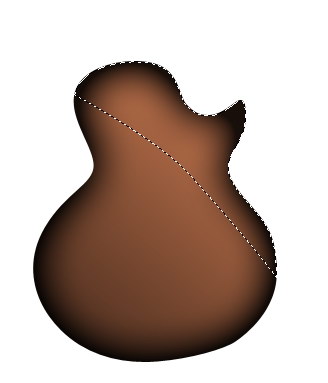
Prepare your Foreground color to white (#ffffff) and then use the Castor Tool (B) to paint inside the selection.
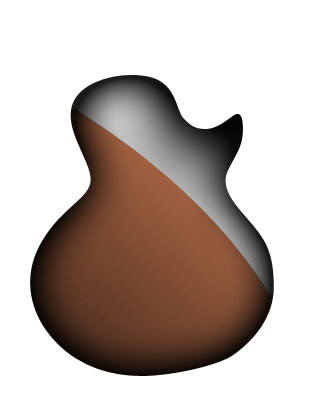
Reduce the layer'southward Opacity to 10%.
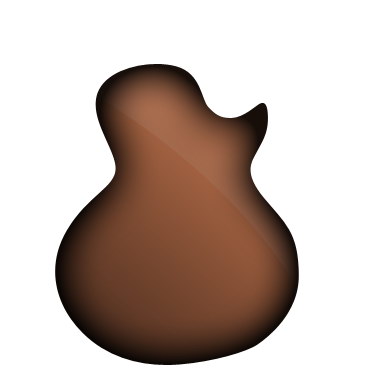
Create a new layer on top of the guitar.
Change the Foreground color to a rosewood carmine (#863c31) and then use the Brush Tool to paint along the edge with a big, soft brush tip.
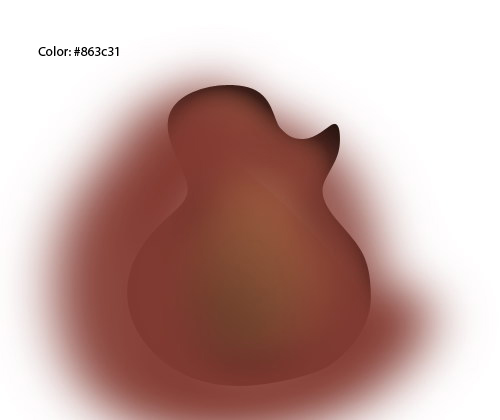
Go to Layer > Create Clipping Mask (Ctrl/Cmd + Alt/Selection + M) to convert the layer to a clipping mask. This way, everything we take painted will only show up inside the body of the guitar.
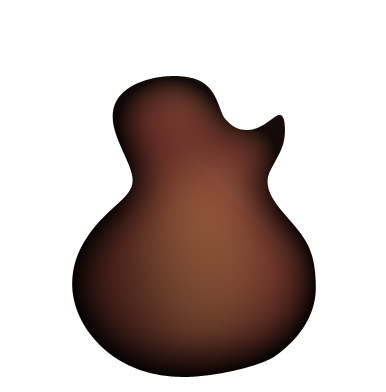
Step 5: Requite the Body'southward Surface a Wood Grain
Create new layer on top of the body and fill information technology with white by going to Edit > Fill up (Shift + F5). Reset the Foreground and Groundwork color to black and white by pressing D. Go to Filter > Render > Fibers.
This Photoshop filter will requite united states of america a nice wood grain surface texture.
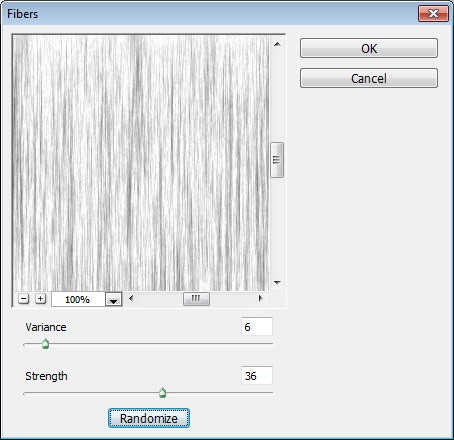
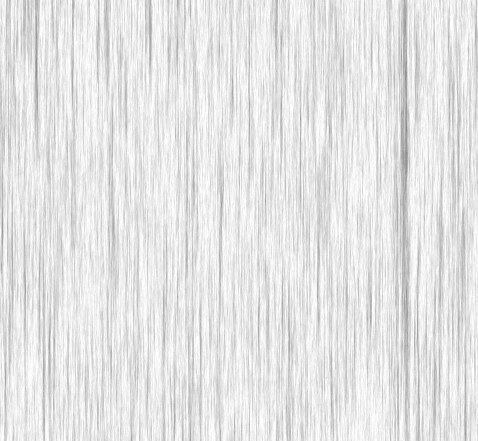
Convert the woods grain layer to a clipping mask (Ctrl/Cmd + Alt/Option + Thou).
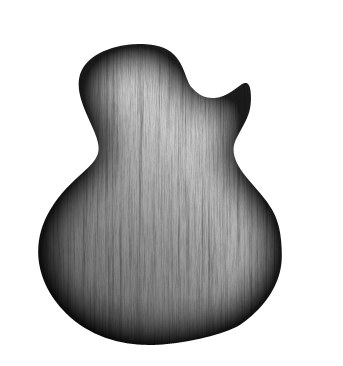
Reduce the wood grain layer's Opacity to 10%.
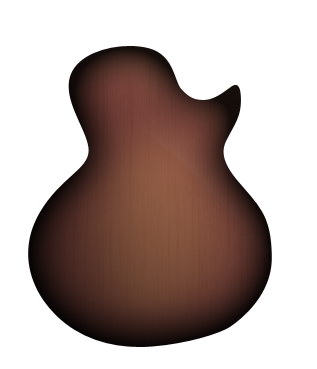
Step 6: Add Surface Details to the Side of the Guitar's Body
Turn on the visibility of the layer containing the left side of the body.
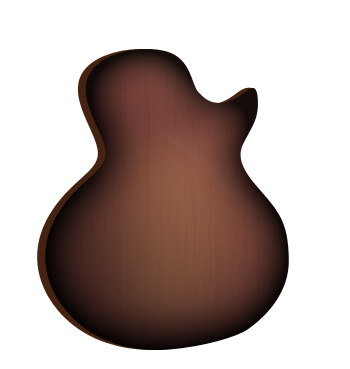
Create a new layer above it and convert this new layer into a clipping mask (Ctrl/Cmd + Alt/Option + G). Switch your Foreground color to white (#ffffff).
Use the Castor Tool (B) to paint white on the clipping mask layer to create some highlights on the side of the body and to strengthen the 3D illusion of the guitar.
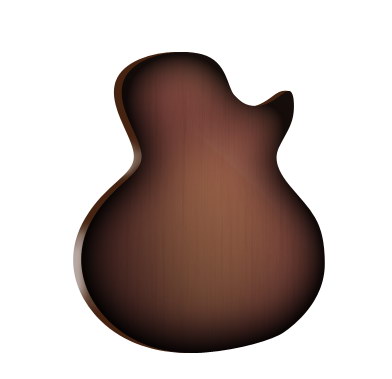
If I temporarily hide the guitar body layer, you lot can see the real brush strokes below:
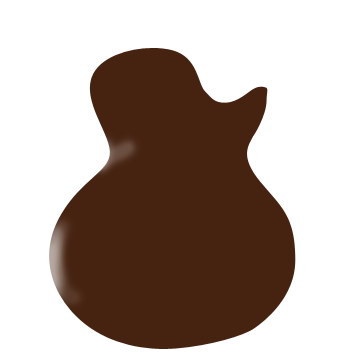
Step 7: Adding More Highlights
Paint some more highlights on other parts of the guitar's body.
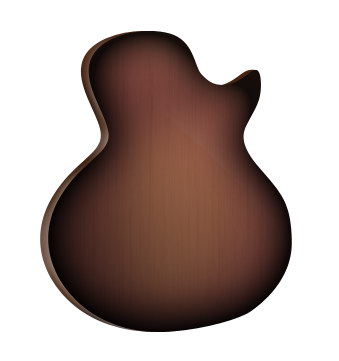
Let's use another highlighting technique. This will produce sharper highlights.
Ctrl-click/Cmd-click on the side trunk layer's thumbnail in the Layers Panel to load a pick effectually the shape.
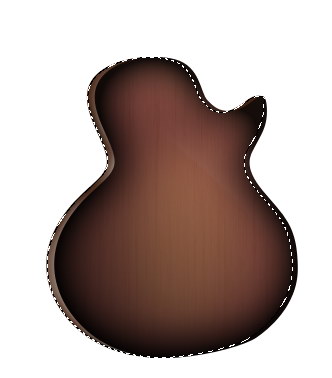
Switch to the Rectangular Marquee Tool (One thousand), right-click/Control-click inside the selection and and then choose Stroke from the menu that appears. In the Stroke dialog window, choose white (#ffffff) for Color and set Location to Inside.
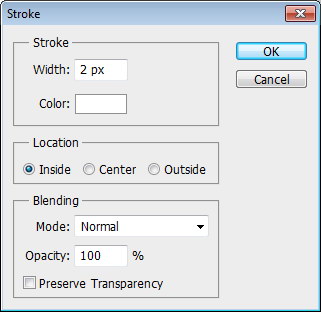
It's hard to run across this white highlight against a white background, so, let'south temporarily change the background color to black.
Adjacent, press the Add layer mask icon at the bottom of the Layers Console, and on the layer mask that is created, paint away parts of the white highlight line with black.
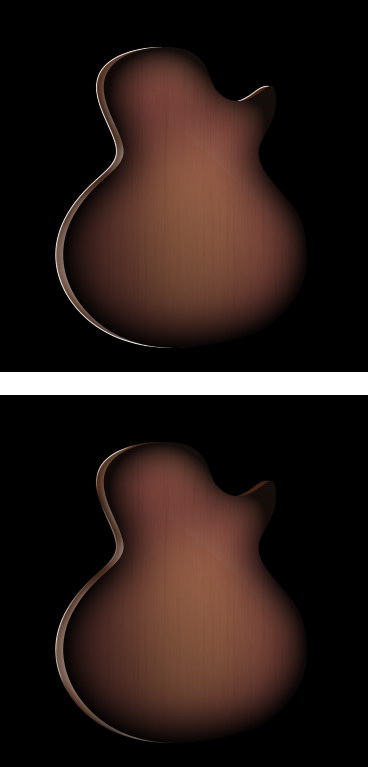
You may observe that after the layer masking that we now have too much calorie-free on the lower portion of the trunk.
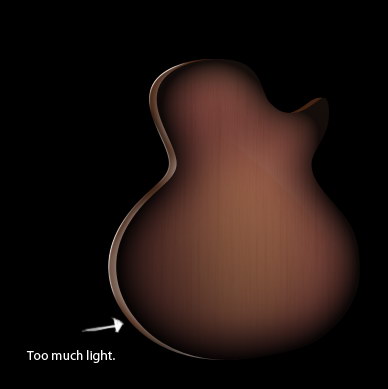
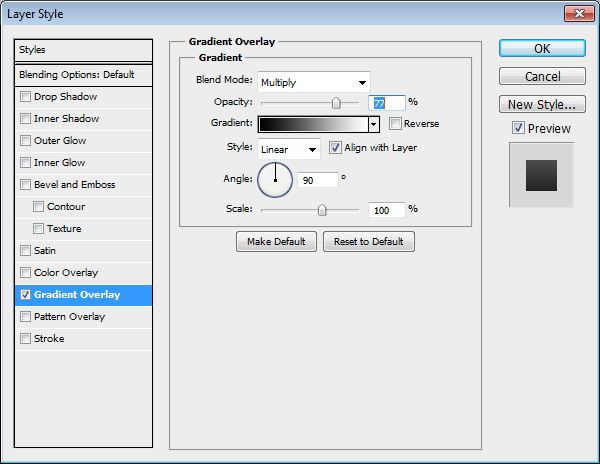
To fix that, we can darken it by adding a Gradient Overlay layer effect. Ready the Blend Mode of the Gradient Overlay layer effect to Multiply.
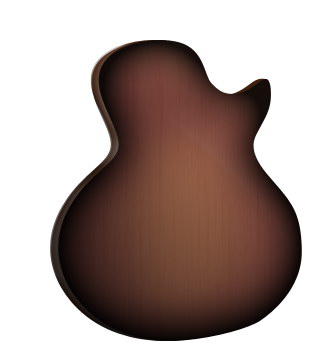
Here's where we're at now:
Let'due south draw an even sharper highlight, merely this time onto the body confront.
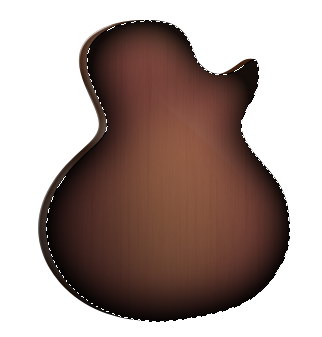
Load a selection effectually the guitar's body face.
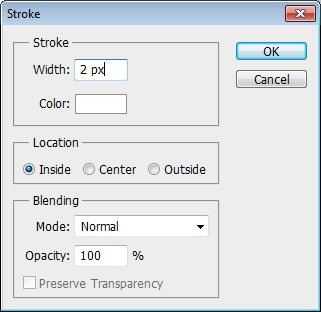
Cull Edit > Stroke, set Width to 2px, Color to white, and Location to Inside.
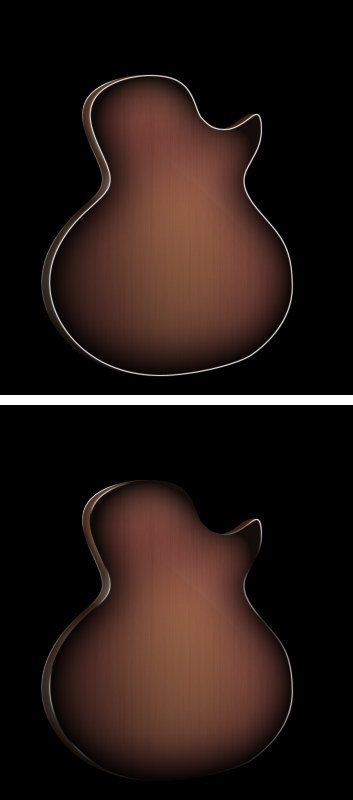
Just similar before, add together a layer mask then, on the new layer mask, paint abroad some of the white highlighting stroke with black.
To help u.s.a. come across the highlight conspicuously, fill the groundwork temporarily with black.
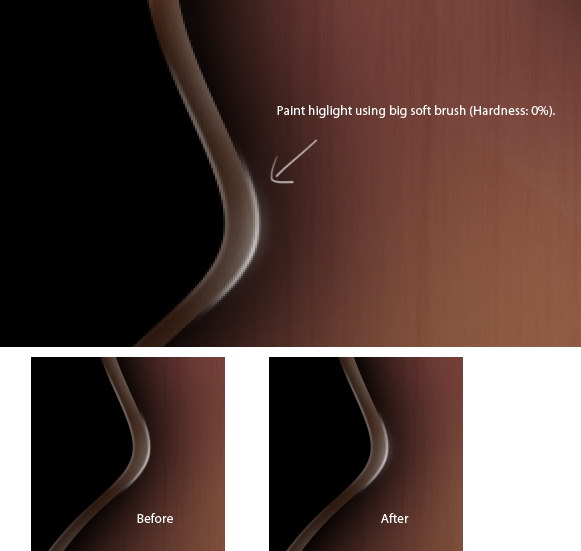
Zoom in very closely to the highlight. Create a new layer and paint white using a big, soft brush.
This volition add a prissy glow onto the highlight.
Stride 8: Describe the Spiral for the Guitar Strap
Electric guitars typically have screws (chosen a strap holder post) and then that guitarists can attach a guitar strap to it. Let'southward draw that at present.
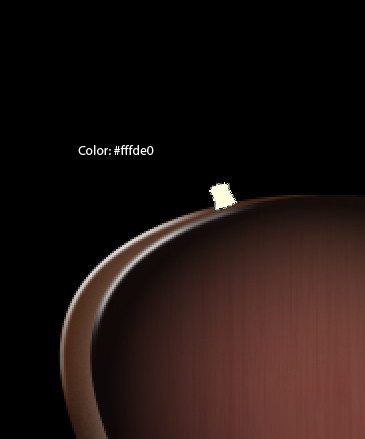
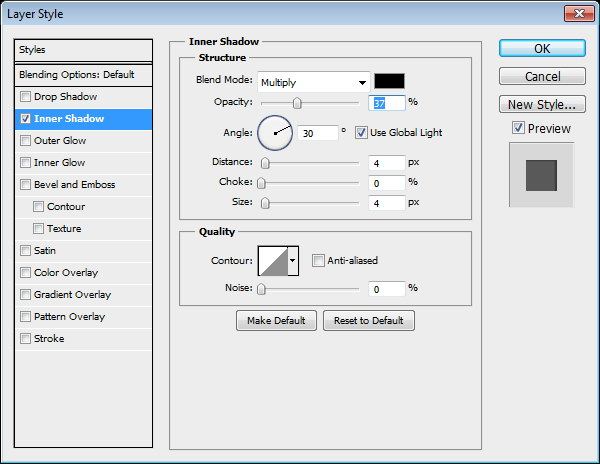
Give the screw an Inner Shadow layer effect.
This screw is very small and then nosotros need to zoom into it in order to work on its details.
Create a new layer and paint some shadows and highlights on the screw to help define its shape. Then depict the meridian part of the screw.
You can run across my drawing progression beneath.
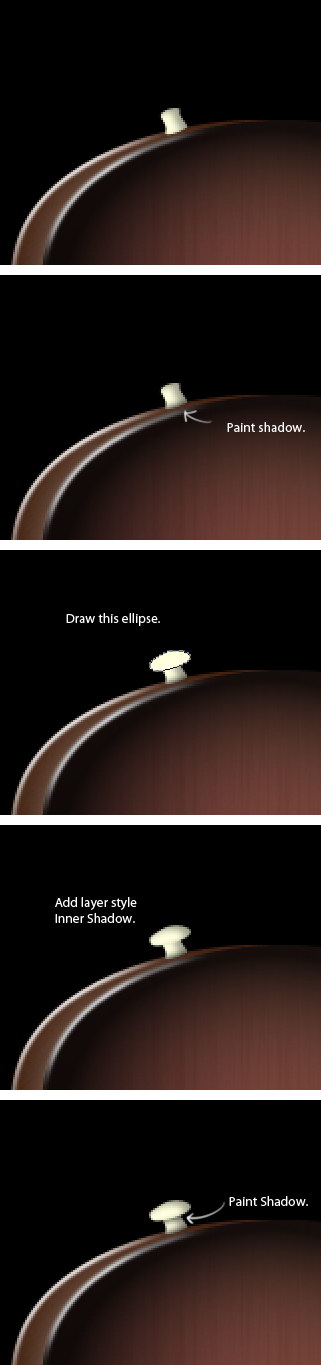
After working with modest details, it'due south always a good practice to constantly cheque it in 100% magnification (press Ctrl/Cmd + ane). You need to make certain that the details look good.
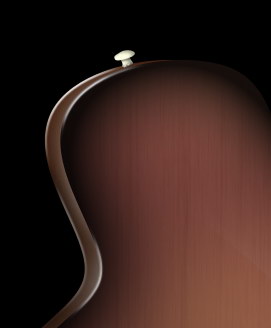
Change the background color to white again. This is where we are with our electric guitar cartoon then far:
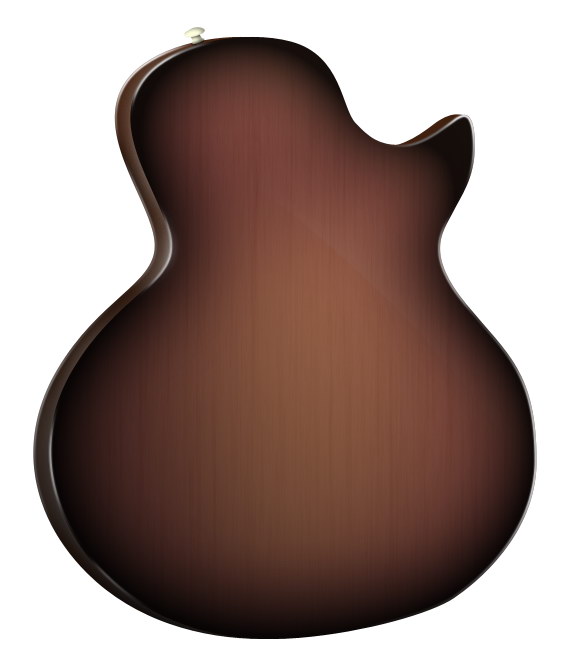
Step nine: Shaping and Shading the Guitar'south Cervix
Toggle the visibility of the guitar neck layer back on.
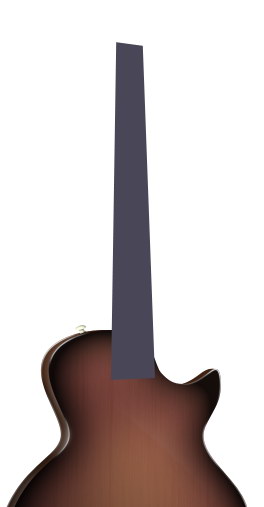
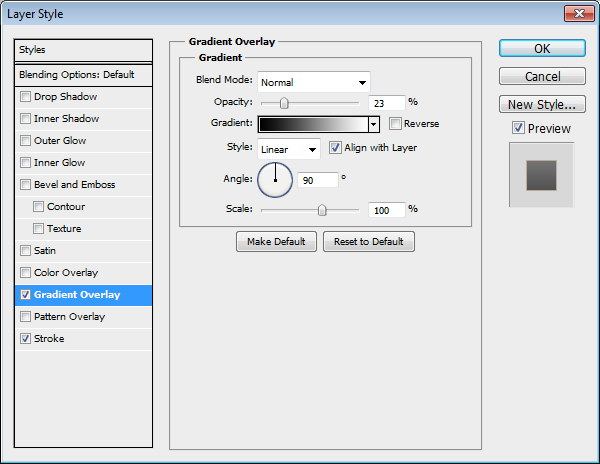
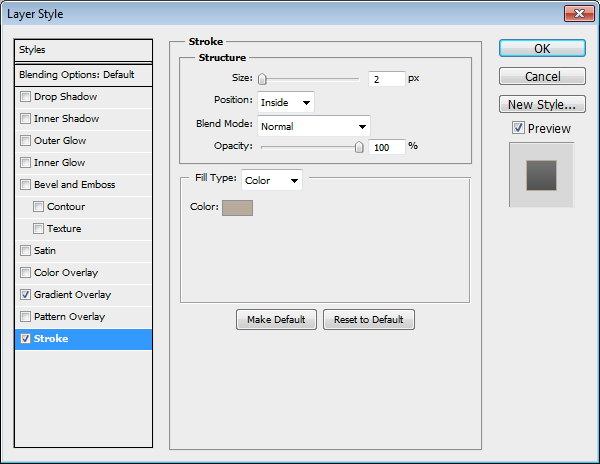
Requite the neck layer a Gradient Overlay layer effect and a Stroke layer effect.
Slope Overlay
Stroke
This is the consequence of the layer mode:
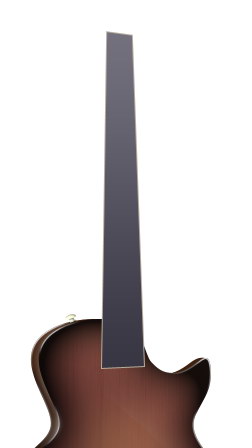
Describe a shape for the dorsum office of the neck. Give the lower part of the neck'south back shape a curve (see the paradigm beneath for reference).
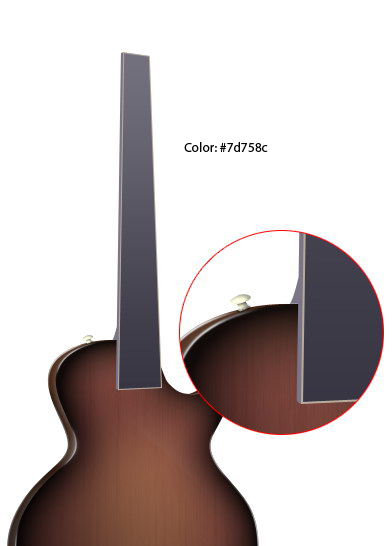
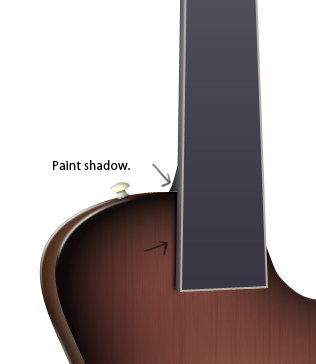
Create a new layer below the neck layers and manually paint its shadows.
Step x: Add Guitar Frets
Draw some white rectangles on the guitar neck to represent its frets. Make certain to match the perspective of the frets to the neck'southward face.
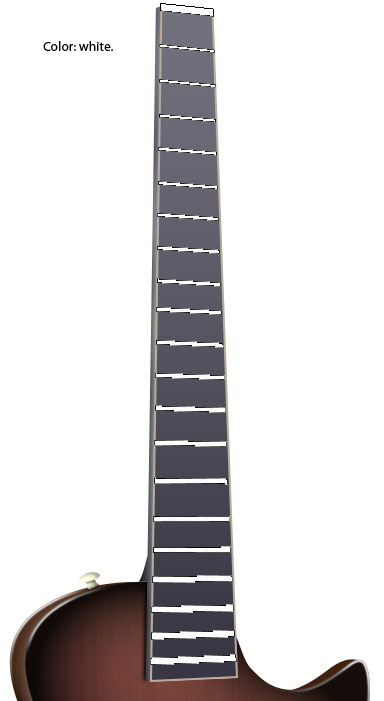
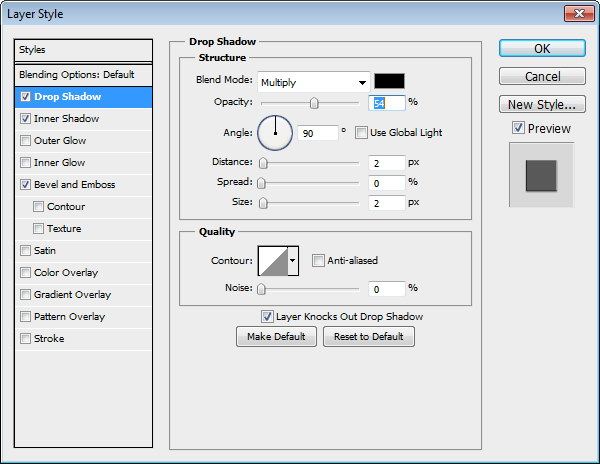
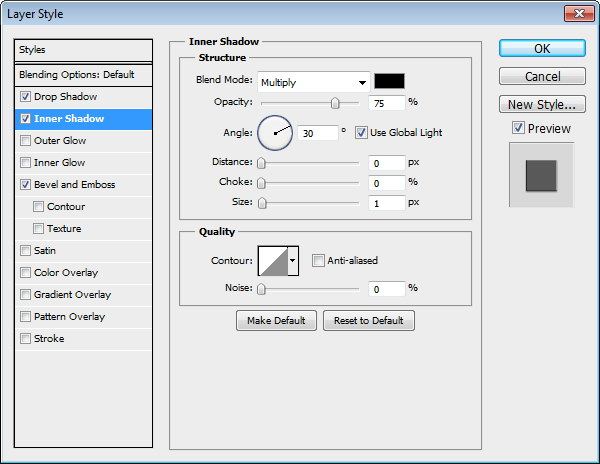
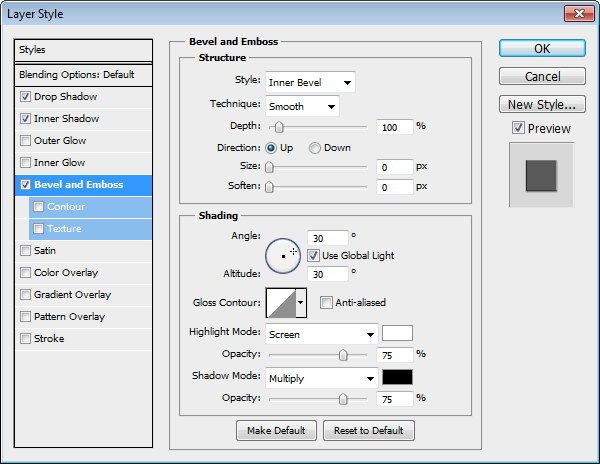
To make the frets look like existent frets, we will utilize a Drop Shadow, Inner Shadow, and Bevel and Emboss layer furnishings.
Driblet Shadow
Inner Shadow
Bevel and Emboss
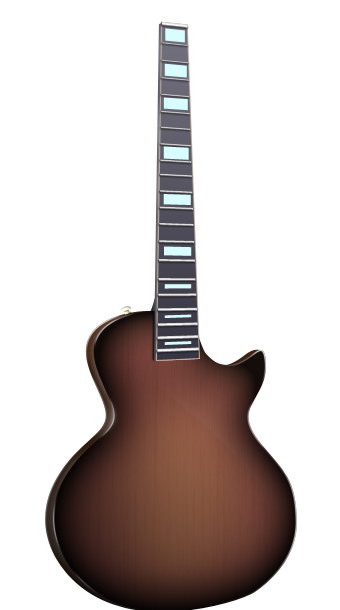
Footstep 11: Add Position Markers on the Neck
The fretboard of guitars usually has some position markers to aid guitarists visualize what frets they're pressing down on. Let's draw these now.
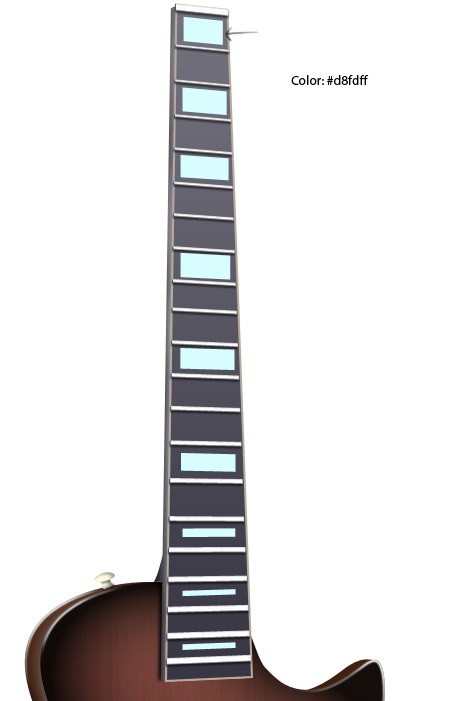
Here is our work so far:
Footstep 12: Add together Some Surface Detailing to the Headstock
Toggle the visibility of the guitar'southward headstock layer back on.
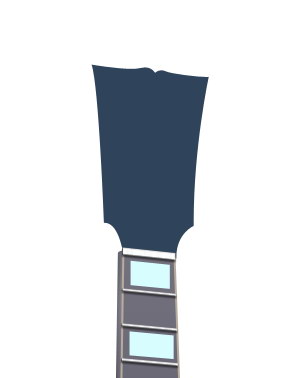
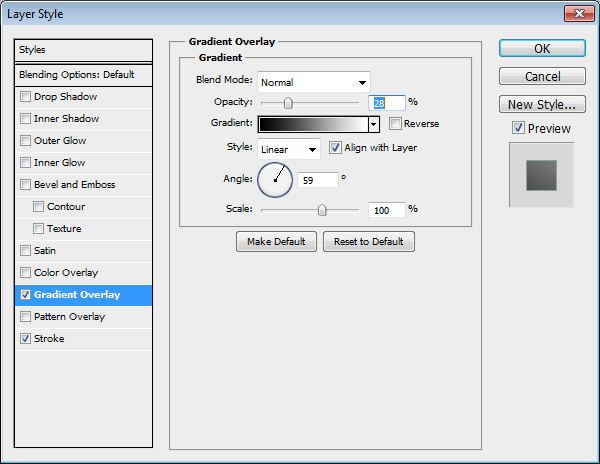
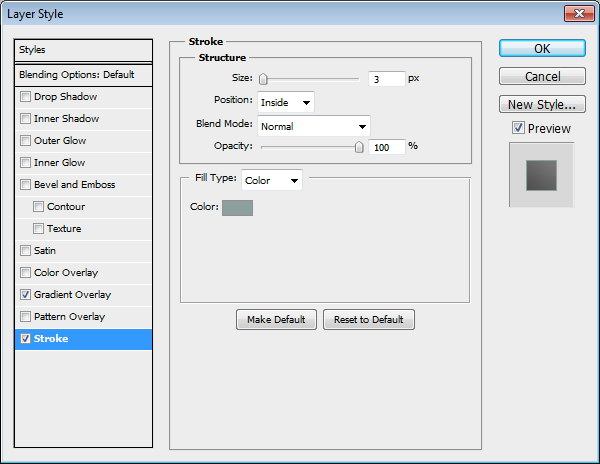
Give this layer a Gradient Overlay and a Stroke. As yous may have surmised by now, I will typically apply a Gradient Overlay to avoid flat, solid colors because in reality, guitars won't have flat colors.
Gradient Overlay
Stroke
Hither'south the headstock of our guitar with the layer style applied:
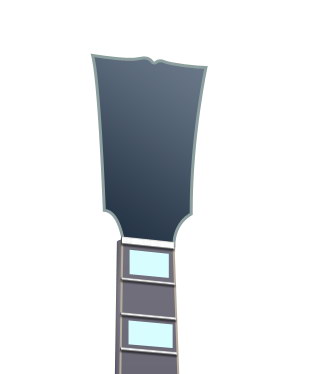
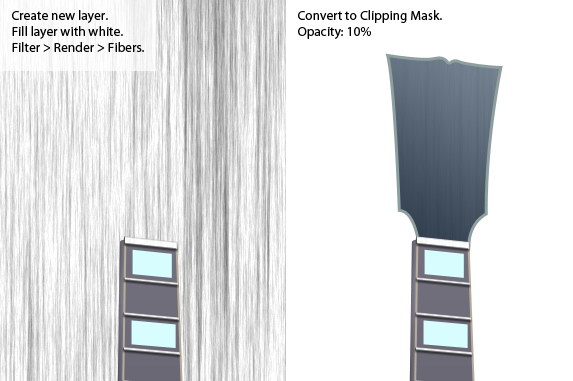
Let the states give the surface of the headstock a wood grain likewise. Create a new layer on tiptop of the headstock. Fill the new layer with white.
Hit D to reset your Foreground color and Background color to default (black and white, respectively). Cull Filter > Render > Fibers. Convert the layer to a clipping mask (Ctrl/Cmd + Alt/Selection + G).
Reduce the layer'due south Opacity to 10%.
Pace 13: Create the Electric Guitar's Bridge
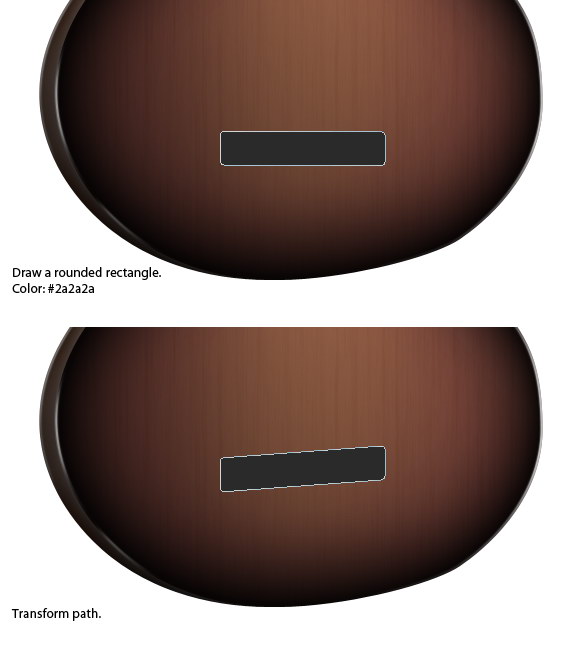
The bridge of a guitar holds the guitar strings in place (along with the headstock). Create a rounded rectangle shape then use Edit > Transform > Skew to match the perspective of the guitar's body.
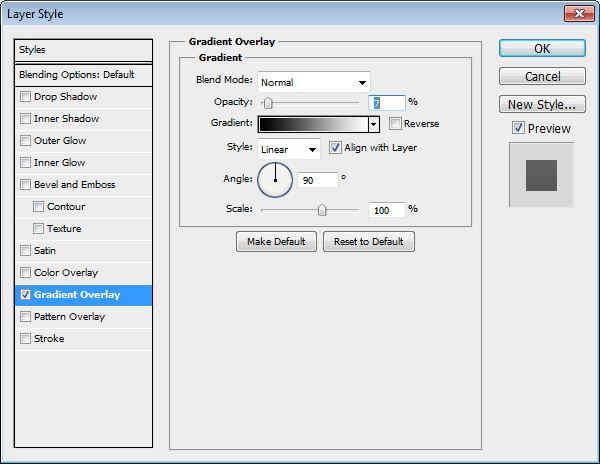
Give the bridge layer a Slope Overlay.
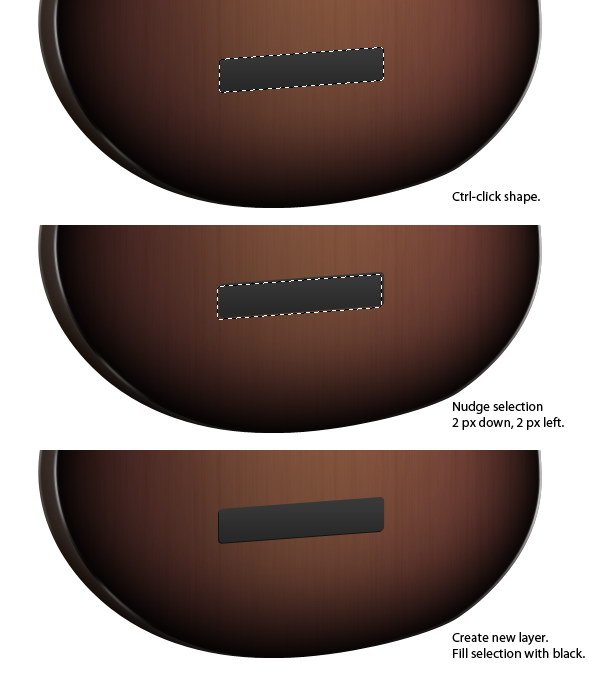
Load a pick around the bridge. Move the pick 2px down and 2px to the left by pressing your Down Arrow central and Left Arrow key twice for each direction. Create a new layer below the bridge layer and then fill the pick with black.
This will add together to our 3D illusion.
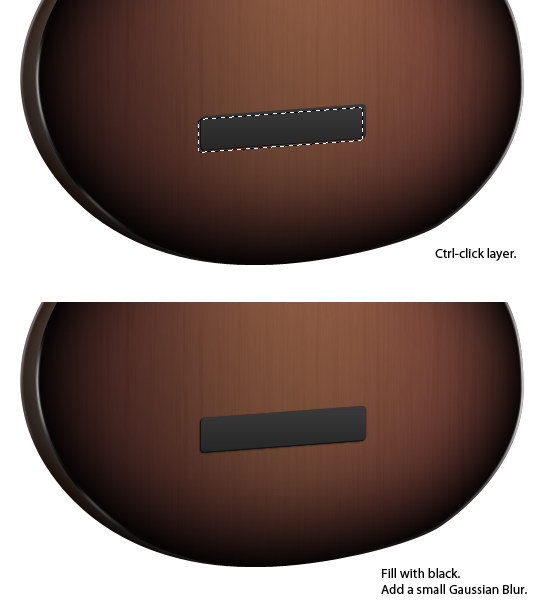
Make certain that you still have a pick around the blackness shape nosotros just created (if not, go to Select > Reselect). Create a new layer below information technology and then make full the new layer with blackness.
Soften the new shape by using the Gaussian Blur filter (Filter > Blur > Gaussian Mistiness) with Radius ready at 0.5px. This will add a soft, subtle shadow backside the span.
Step 14: Draw the Saddle of the Guitar
Nosotros volition draw the saddle that sits on top of the bridge; its purpose is to prop up the guitar strings and make sure they are taut.
Create a smaller rounded rectangle on top of the bridge and conform it as necessary to match the guitar's perspective.
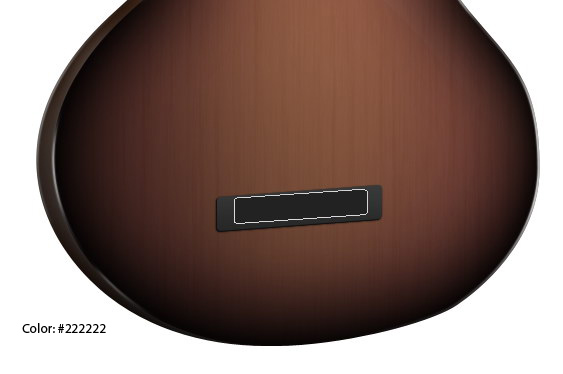
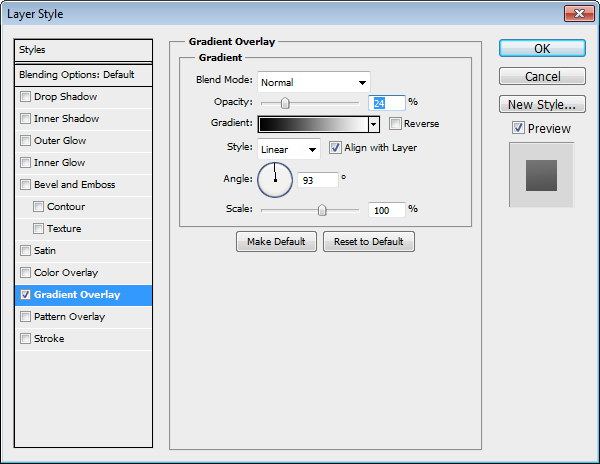
Give the saddle a Gradient Overlay.
Echo the previous procedure that we used on the bridge to give the saddle a 3D look. A quick refresher: Duplicate the shape, nudge the duplicate 2px down and 2px to the left, load a selection effectually it, fill the selection with black, then apply the Gaussian Blur filter to soften information technology upward.
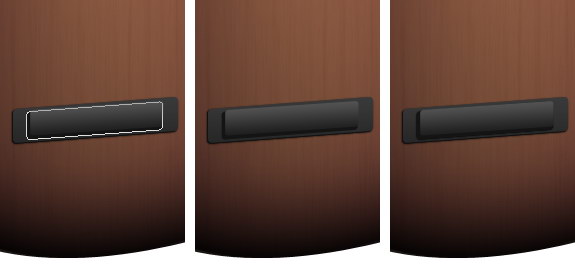
Footstep 15: Draw the Treble Pickup
An electric guitar will unremarkably have several pickups. Pickups are the receivers of the string vibrations (that happen when the guitar strings are strummed by the guitarist). The pickup located closest to the bridge of the guitar is usually the treble pickup.
We can create this pickup using the same process nosotros used with the span and saddle; the only departure is the shape.

Hither's where nosotros are now:
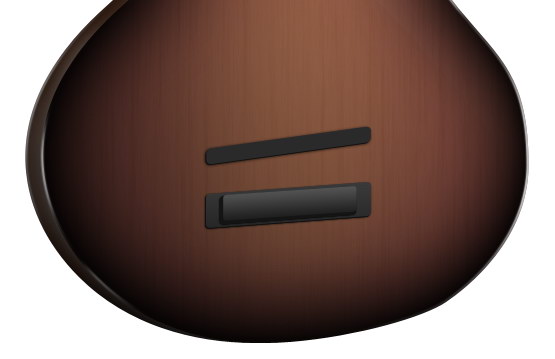
Draw a smaller rounded rectangle on top of the pickup. Okay, you lot know the drill by now: Duplicate information technology, nudge information technology 2px downwards and 2px left, and and so add a shadow using the Gaussian Blur filter.
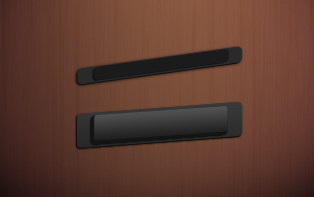
Let'southward add a highlight on the pickup. Load a selection around the pickup. Create a new layer.
Get to Edit > Stroke to stroke the selection — use white for the stroke colour and Inside for the location of the stroke.
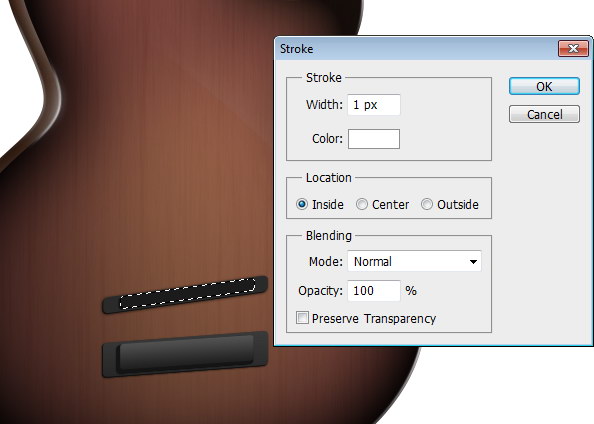
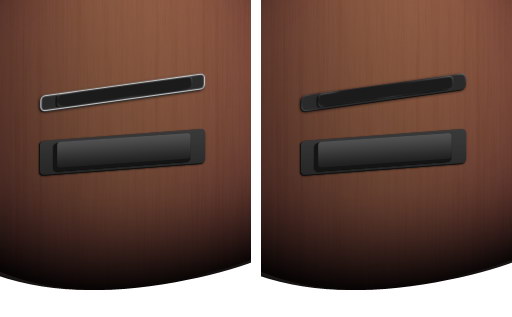
Add a layer mask and pigment away some sections of the white stroke with black.
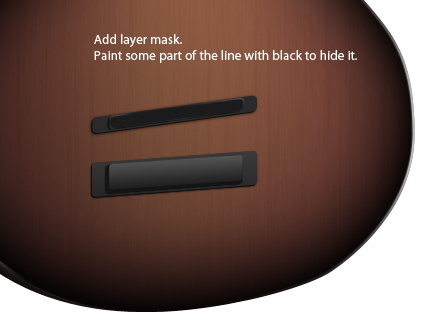
Requite the bigger rounded rectangle a highlight using the aforementioned procedure.
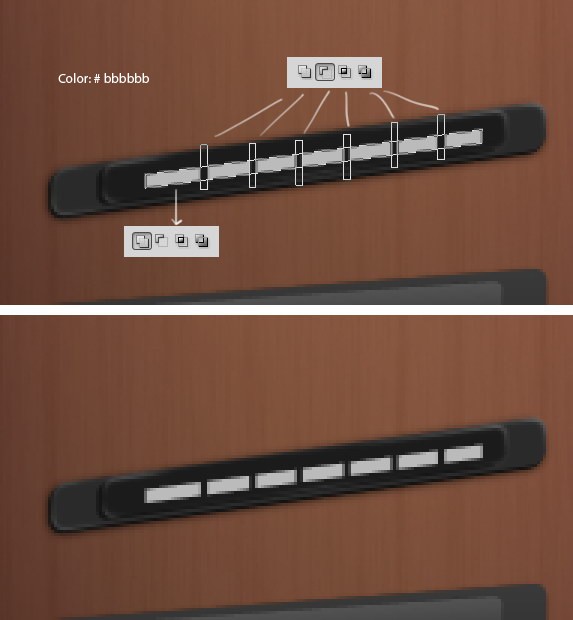
On top of the rounded rectangle, draw a long rectangle then skew information technology using the Edit > Transform > Skew command. Switch to the Rectangle Tool and, in the Options Bar, choose the Decrease from shape area (-) option. Draw narrow rectangles until y'all have 6 of them (because a guitar has half-dozen strings).
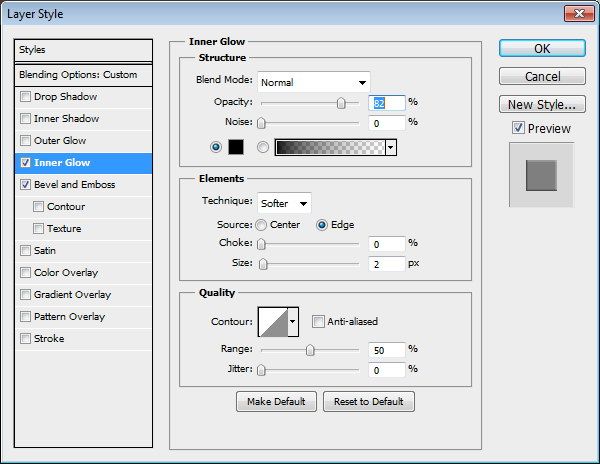
Give the layer an Inner Glow and Bevel and Emboss layer way.
Inner Glow
Bevel and Emboss
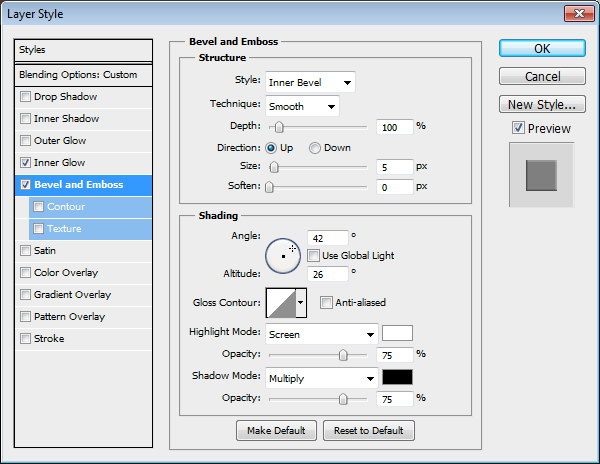
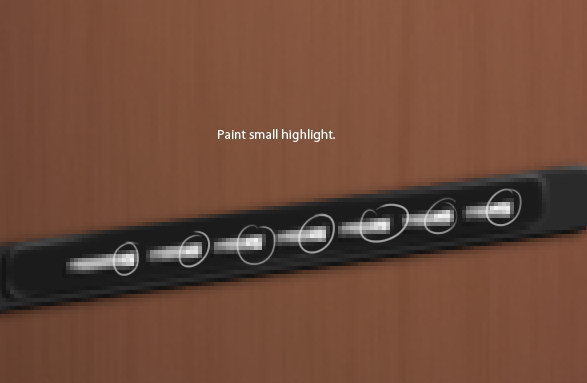
Create a new layer then utilise the Castor Tool to paint small highlights on peak of each rectangle. These highlights are very small; you'll demand to zoom in for accuracy and use a castor master diameter of 1px.
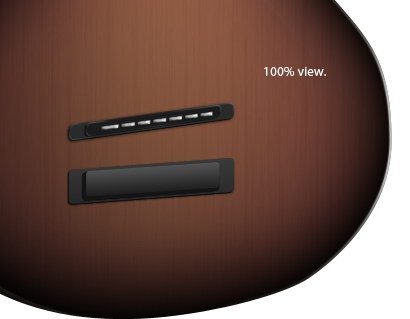
Here'due south our pickup at 100% view.
Y'all can see that many small-scale details add upward to smashing results.
Step 16: Create the Eye Pickup
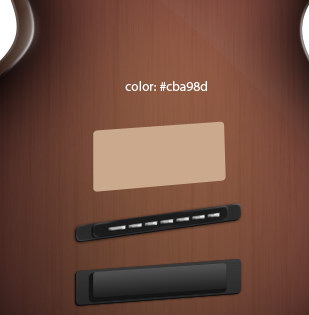
Create a bigger rounded rectangle and make transformations on information technology until yous get a shape similar to what's shown below.
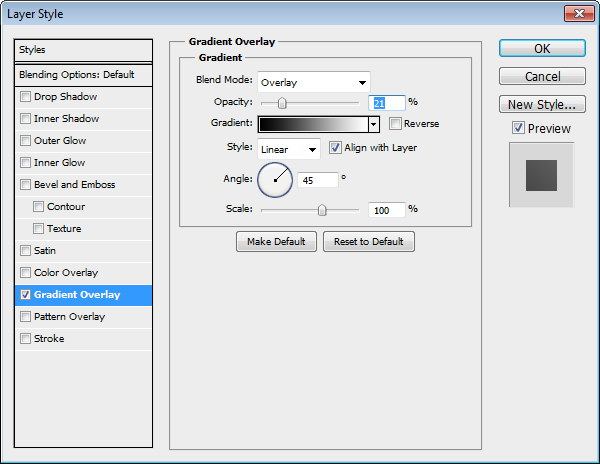
Give this layer a Gradient Overlay layer effect.
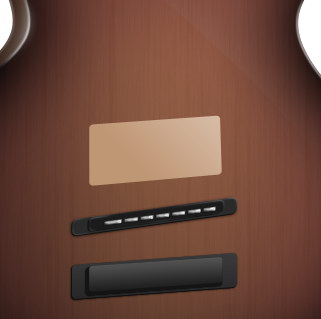
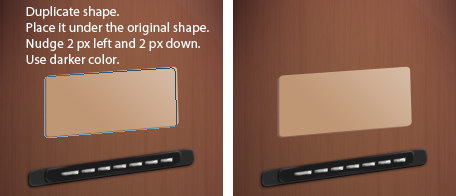
Use the same technique that we used on the bridge and treble pickup to requite the heart pickup a 3D appearance: Duplicate the shape, place it behind the original shape, nudge it 2px to the left and 2px downward.
Alter the color of the shape beneath to a darker colour.
To add a shadow, starting time, load a option effectually the shape. Create a new layer under the shape, fill it with black, and then soften it upwards with the Gaussian Blur filter.
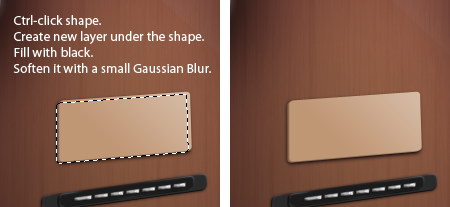
Repeat the same process we've used several times to create a dark rounded rectangle on top of it.
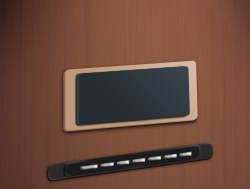
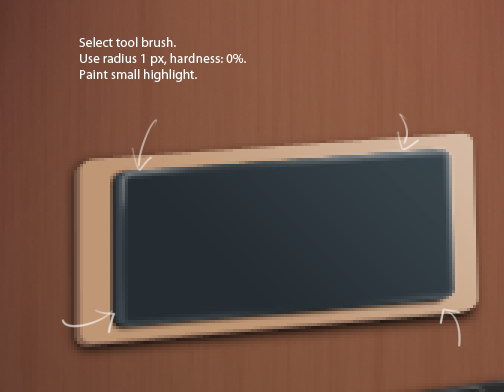
Let'southward requite information technology a stroke highlight (similar to what we've already done before). We can use the Stroke command or, for meliorate results, we can utilise a pocket-sized brush with a master diameter of 1px and Hardness at 0% to manually paint the white highlights on the edge.
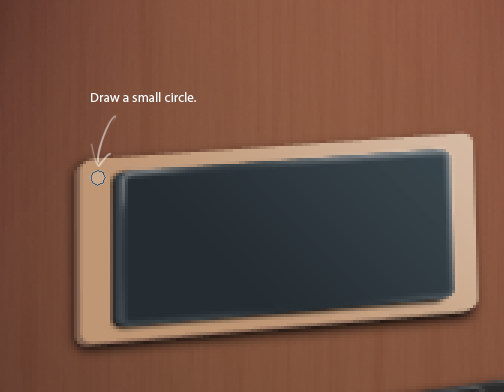
Let's hold downwards the middle pickup with some screws. Describe a small circle shape located at the elevation left corner.
Requite the circumvolve a Gradient Overlay (gear up the slope style to Radial).
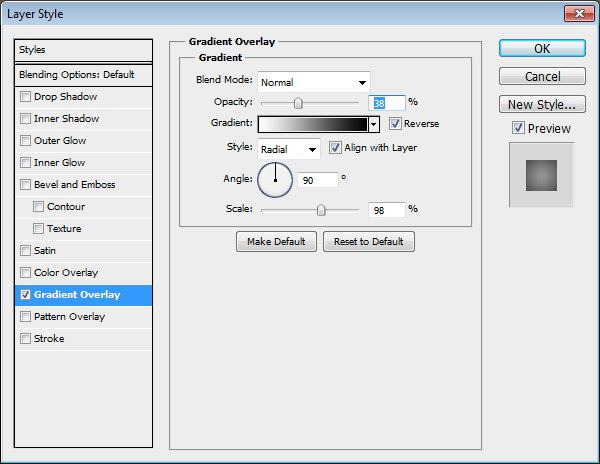
As you can see, the radial colour gradient converts the flat circle into a ball that looks like a screw's head.
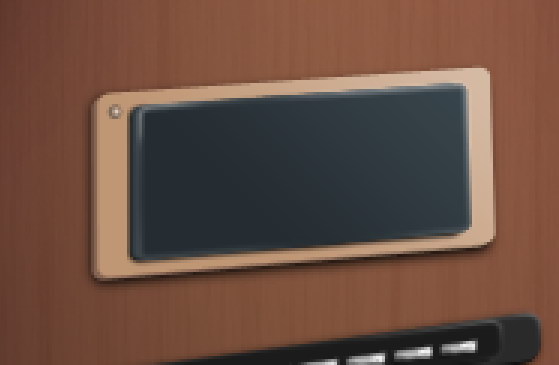
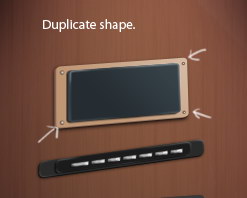
Duplicate the screw and place it on each corner. Continue in mind basic perspective and viewpoint principles: The farther something is from the viewer, the smaller information technology should be.
Thus, the two screws on the correct side should exist smaller than the ones on the left. You can modify the sizes using the Gratuitous Transform control.
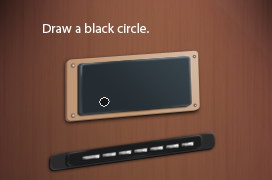
Electric guitar pickups will have these fixed pole pieces to pick up the sound of each guitar string.
We'll need to describe six black circles on top of the pickup to represent these poles. Draw only one for now, and then we'll duplicate information technology later to complete the set up.
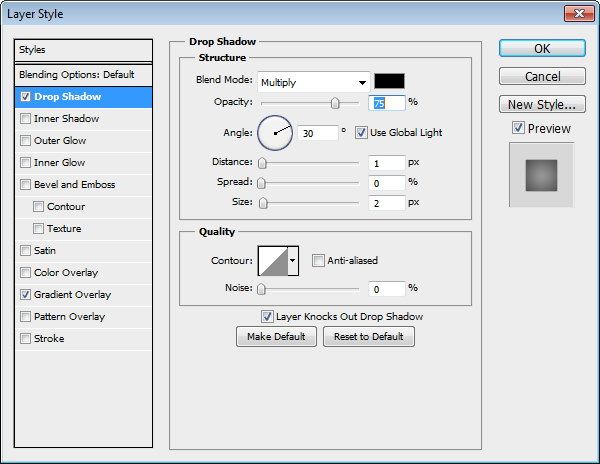
Give the black circle a Driblet Shadow and Gradient Overlay.
Driblet Shadow
Gradient Overlay
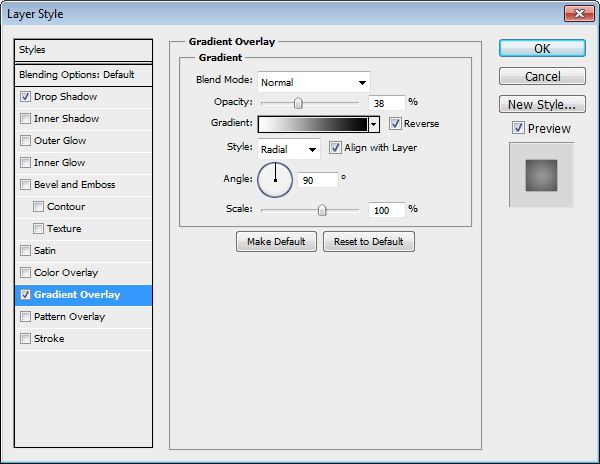
Indistinguishable the circle five times and position them accordingly.
Here's our finished middle pickup:
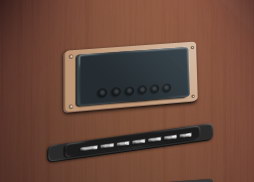
Step 17: Create the Bass Pickup
The topmost pickup is more sensitive to bass sounds, and is closest to the neck of the guitar. Let's draw this last pickup.
Utilise the same technique we used for the middle pickup to create the bass pickup, positioning information technology right nether the guitar's neck.
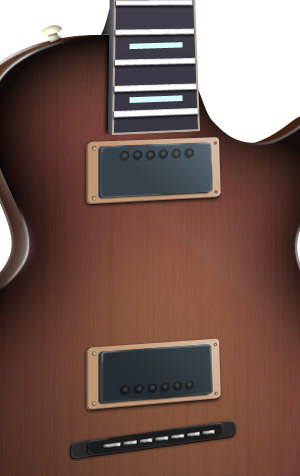
Pace 18: Draw the Machine Heads/Tuners
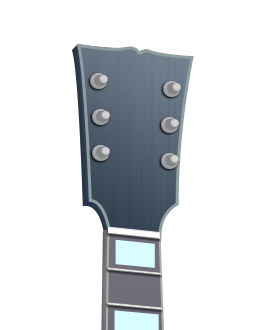
On the headstock are six car heads that can be turned to adapt the melody of the strings. Permit's create these automobile heads. Nosotros will employ Adobe Illustrator to help the states hither, so burn down upward that software if you haven't already.
In Illustrator, draw the shape shown below using the Pen Tool. Set the Fill up color to None and Stroke color to a greyness color.
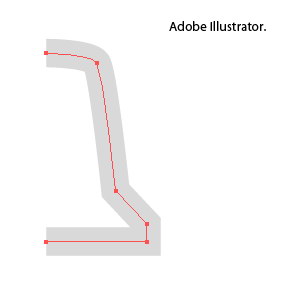
Next, go to Outcome > 3D > Circumduct.
It might take a while until nosotros tin can observe just the right settings for this 3D rendering.
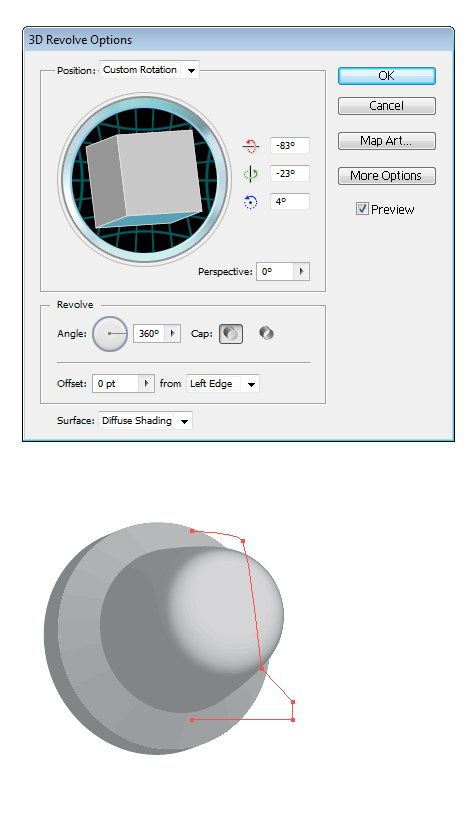
After you lot're happy with the 3D rendering, select the object and re-create it to the clipboard. Return to Photoshop.
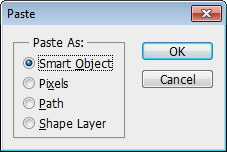
Hitting Ctrl/Cmd + Five to paste the object from your clipboard; when prompted by the Paste dialog window, cull Paste As: Smart Object. Past importing the Illustrator object as a smart object in Photoshop, nosotros can retain its vector characteristics and preserve the integrity of the original 3D render.
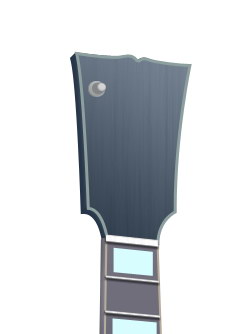
Identify the 3D object on top of the headstock.
If, at this signal, it doesn't look correct to you, double-click the layer, which will switch you back to Illustrator to permit y'all to make more edits. Change the perspective settings on 3D Revolve options until you're satisfied. Relieve the Illustrator file, then return to Photoshop once more and you'll encounter that the object will have updated itself automatically.
Switch to the Move Tool (V). Hold Ctrl/Cmd then click-and-drag on the object to duplicate it. Do this repeatedly until you have six of them.
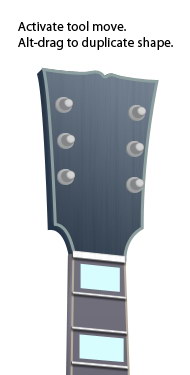
Create a new layer under the objects. On this new layer, castor on some shadows.
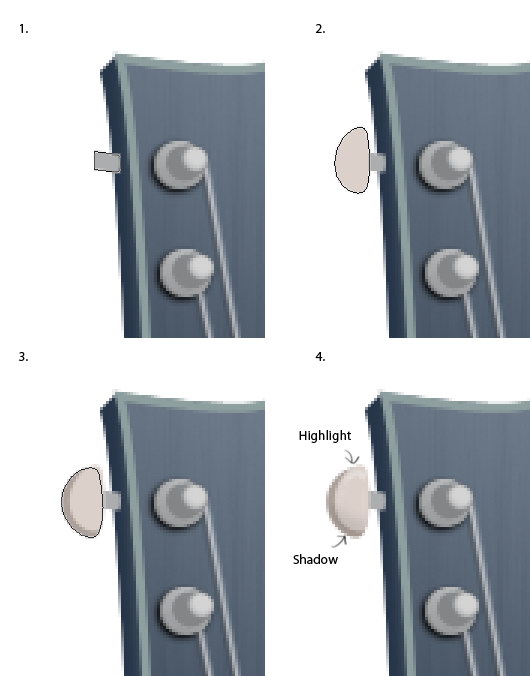
The tuning pegs on the side of the headstock are fabricated from 3 elementary shapes.
First, we create a rectangle. On top of the rectangle, we create an elliptical shape using the Pen Tool (P). Behind the elliptical shape, we demand to depict a like shape, only with a darker colour.
Those are the 3 shapes. And then, we need to create a new layer on top of the shapes for painting on highlights and shadows.
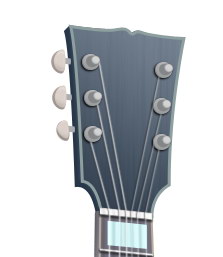
Duplicate the tuning peg until you have three of them on the left side.
To make them expect realistic, you need to modify some of them to make them appear as though they are in different positions.
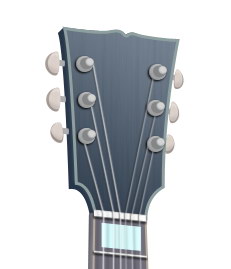
Duplicate the three tuning pegs so utilize Edit > Transform > Flip Vertical. Because of our perspective, place these three tuning pegs behind the headstock layer and scale them downwards since they are further away from the viewpoint.
Footstep xix: Draw the Guitar Strings
Apply the Brush Tool (B) to draw half-dozen guitar strings. Hold Shift to create a perfect line. I advise you depict the string using your mouse (not a graphics tablet) to get equal weights on both ends considering in that location'southward a big chance that your tablet pressure settings are active.
Y'all can deactivate the settings, of course, merely it's just equally quick to switch to your mouse and click.
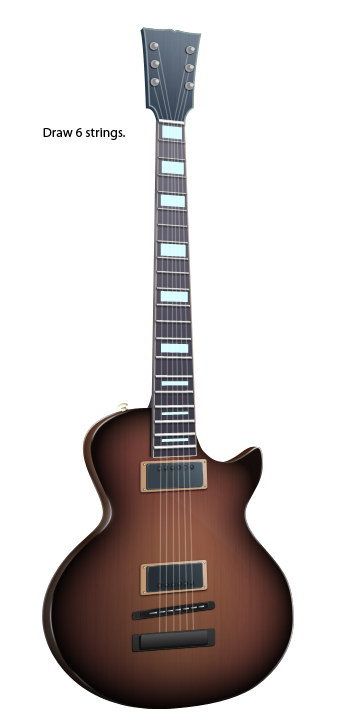
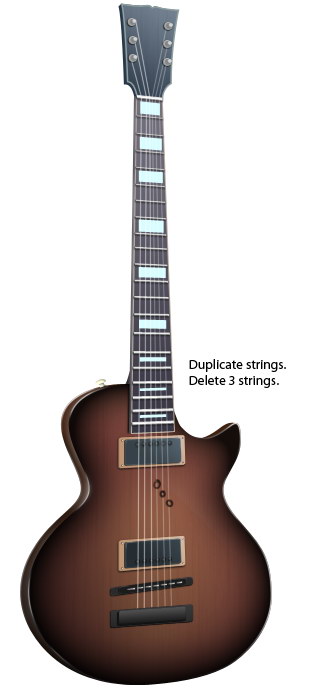
The beginning iii strings on the left should be thicker than the residue. To practice that, we merely need to indistinguishable the strings layer by pressing Ctrl/Cmd + J then, on the duplicate layer, delete the other three strings on the right.
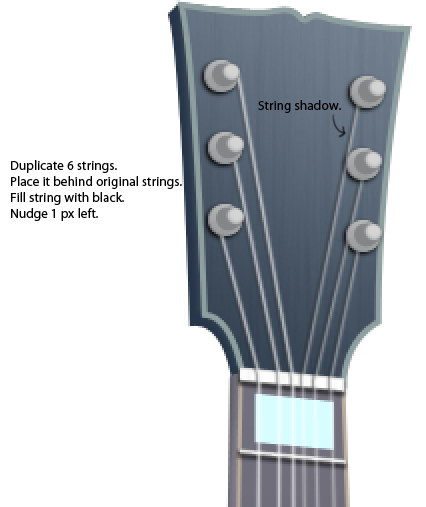
Duplicate the guitar strings layer and modify the cord's color to blackness past setting your Foreground color to blackness then hitting Shift + Alt/Option + Delete. Nudge it 1px to the left, creating shadows on the strings.
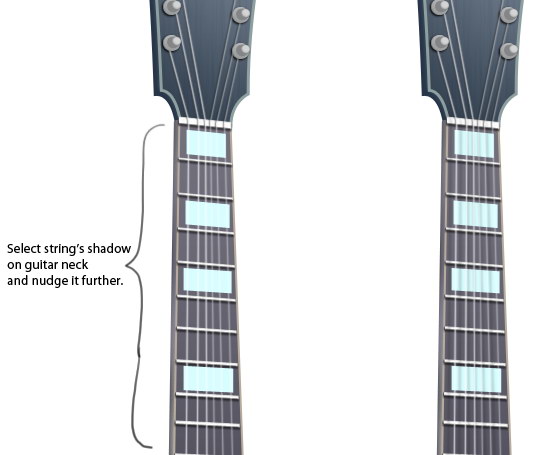
Nosotros don't want the strings' shadows to be apartment.
If you have ever seen a real guitar (and I'm sure you have), you may observe that the cord's distance to the guitar neck and body is varied. And then, select the strings' shadows on the guitar neck and body, so nudge it further. You can see the difference before and after nudging, below:
Step 20: Create Volume and Tone Controls
Render to Illustrator and create the post-obit shape.
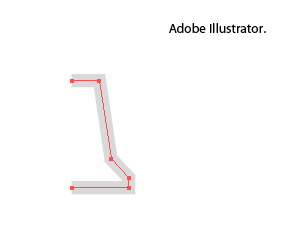
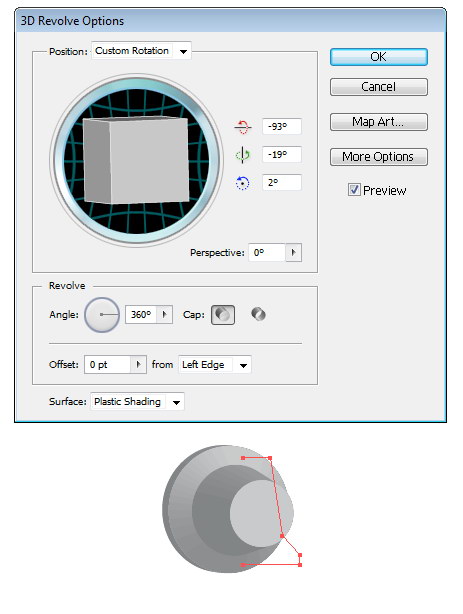
Get to Effect > 3D > Circumduct. Experiment with the settings to find the perfect perspective settings for your guitar.
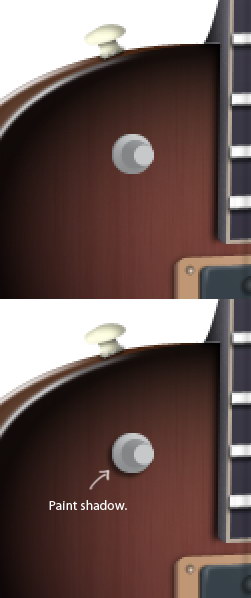
Paste the command into our Photoshop document as a smart object. Create a new layer underneath it and paint its shadow.
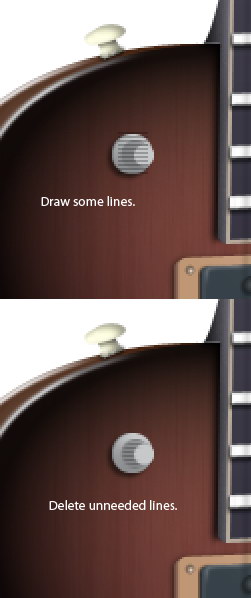
Draw lines on height of the control and then delete parts of information technology.
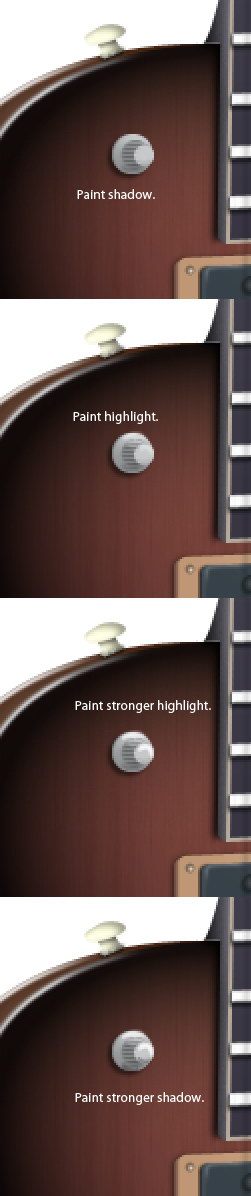
Create a new layer for shadows and highlights. Y'all tin can run across the progression of the shadow painting below.
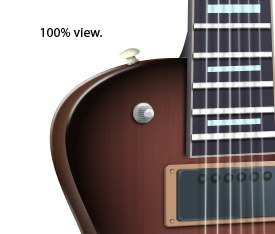
Hither'due south the command at 100% view:
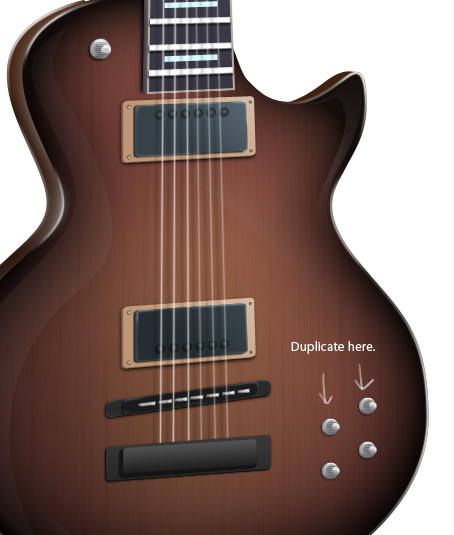
Indistinguishable the command several times and place them on the lower right side of the guitar.
Step 21: Working on the Backdrop
We are at present done with our guitar. Next, allow's create a proficient, complementary background for it.
To start, on a new layer, create a soft radial gradient that goes from white at the center to gray.
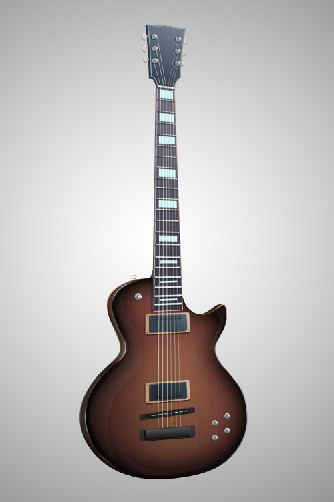
Create a new layer and fill up it with white. Go to Filter > Render >Fibers.
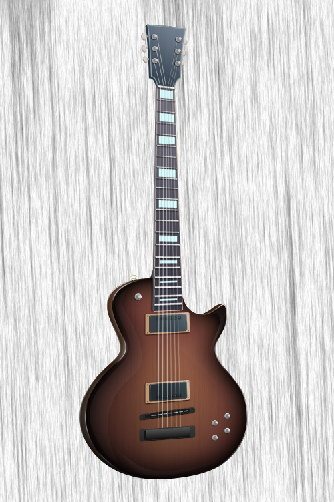
Reduce the layer'due south Opacity to ten%.
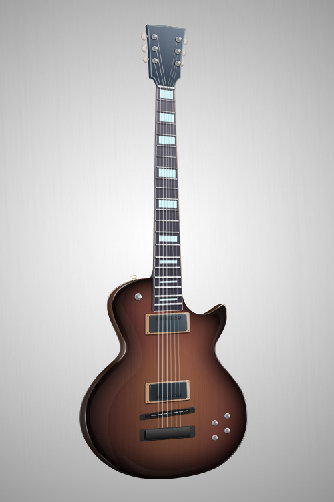
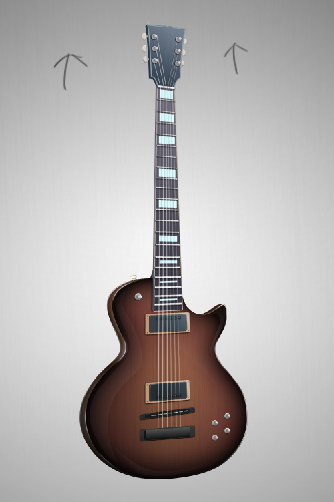
I retrieve the top part of the background is also light, washing abroad the details on the neck that nosotros've put so much effort into. Let'due south prepare that. Create a new layer and pigment the top part of the background with black.
Afterwards, reduce the layer's Opacity to 20-25%.
Stride 22: Create the Floor
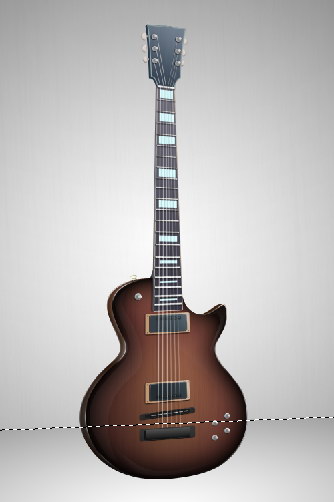
Use the Polygonal Lasso Tool to make a selection on the lower part of the canvas. Paint some parts of the option with gray. This is going to be our floor.
Step 23: Creating a Realistic Guitar Shadow
Load a choice around the entire electric guitar. Create a new layer and then fill the selection with black on the new layer. Nosotros're going to apply this every bit a shadow layer.
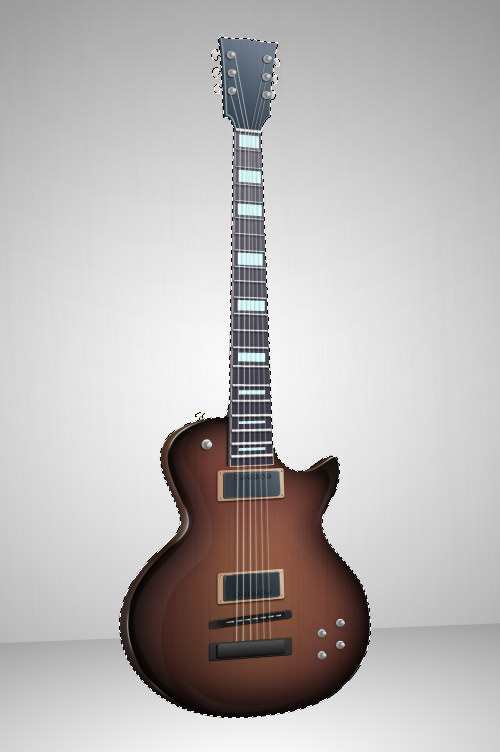
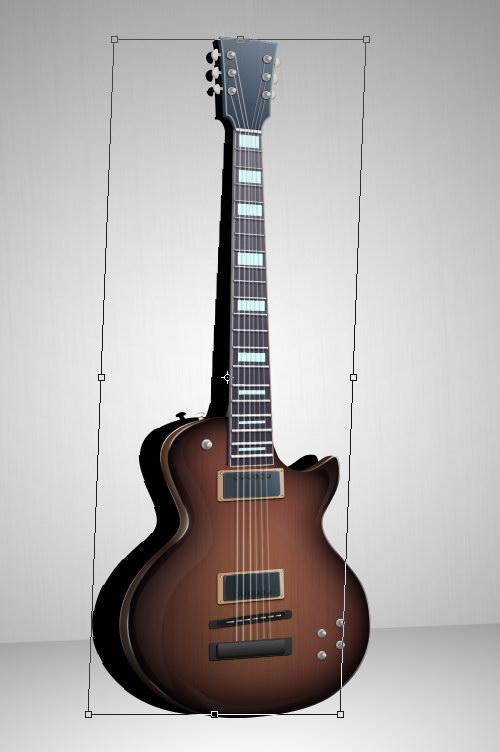
Printing Ctrl/Cmd + T to activate Free Transform. Concord Alt/Option to skew the shadow then that it matches the wall'south perspective behind information technology, equally though the shadow was existence casted on information technology.
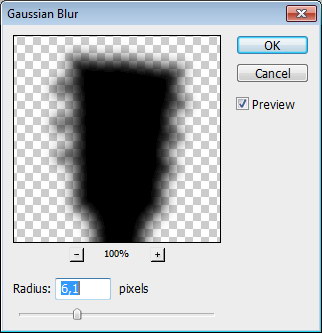
Soften the guitar'due south shadow using the Gaussian Mistiness filter.
Here'southward the result of the shadow:
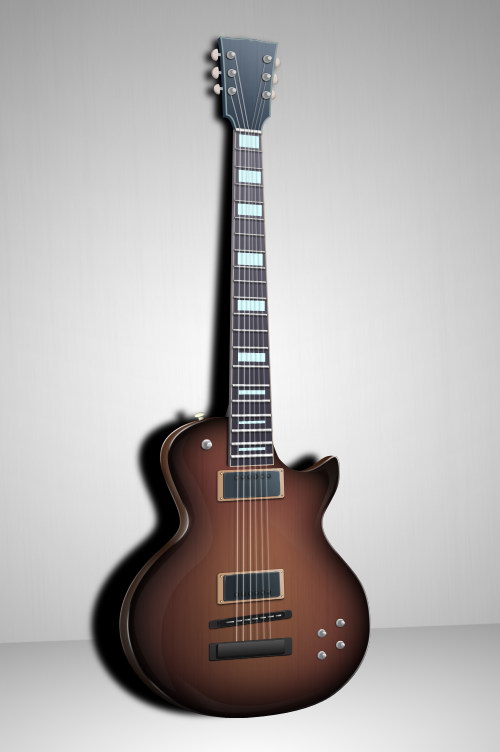
This shadow is too potent, and so let'due south reduce the layer's Opacity to 50-threescore%.
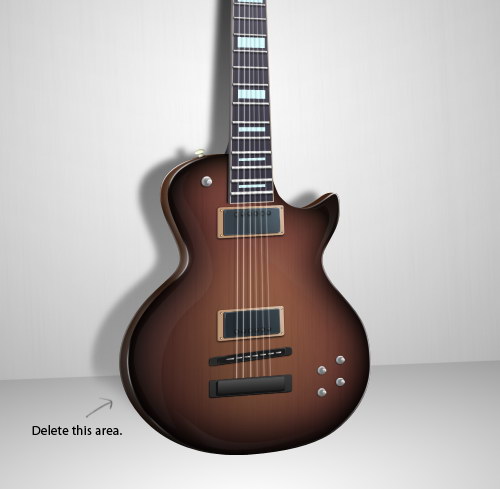
Remove the lower office of the shadow since this part should exist hidden backside the guitar.
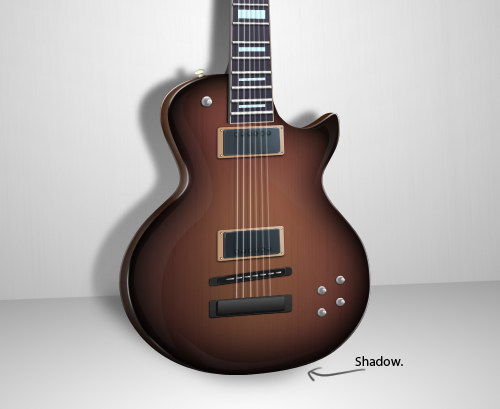
We need shadows on the flooring as well.
Create a new layer for it and paint some shadows under the guitar.
We're done!
Tutorial Summary
Finally, nosotros are done with the guitar! Nosotros covered a lot of Photoshop drawing techniques in this tutorial, keeping in heed that we wanted to produce realistic results. We also used Illustrator'southward powerful 3D furnishings to depict some components of the electric guitar.
I hope yous enjoyed this Photoshop tutorial and take picked upward some useful tricks and techniques!
Download Source Files
- electric_guitar (Nada, 22.iv MB)

Source: https://www.webfx.com/blog/web-design/how-to-draw-a-classic-electric-guitar-in-photoshop/
Posted by: parkblegame94.blogspot.com
0 Response to "How To Draw A Simple Guitar"
Post a Comment