

How To Center An Isometric Drawing
Coordination System..
Piping Isometrics
Different orthographics, pipage isometrics allow the pipage to be drawn in a style by which the length, width and depth are shown in a unmarried view. Isometrics are unremarkably drawn from information found on a program and elevation views. The symbols that represent fittings, Valves and flanges are modified to adapt to the isometric grid. Usually, piping isometrics are fatigued on preprinted newspaper, with lines of equilateral triangles form of 60°.
The Iso, as isometric are commonly referred, is oriented on the grid relative to the north arrow establish on plan drawings. Because iso's are not fatigued to scale, dimensions are required to specify verbal lengths of pipage runs.
Pipe lengths are determined through calculations using coordinates and elevations. Vertical lengths of pipe are calculated using elevations, while horizontal lengths are caculated using n-s and eastward-west coordinates.
Piping isometrics are generally produced from orthographic drawings and are important pieces of information to engineers. In very complex or large piping systems, pipe isometrics are essential to the design and manufacturing phases of a project.
Pipage isometrics are often used by designers prior to a stress analysis and are also used past draftsmen to produce store fabrication spool drawings. Isometrics are the most important drawings for installation contractors during the field portion of the projection.
How to read a Piping Isometric..
A pipage into a isometric view, is e'er drawn by a single line. This single line is the centerline of the piping, and from that line, the dimensions measured. So, not from the outside of a pipage or fitting.
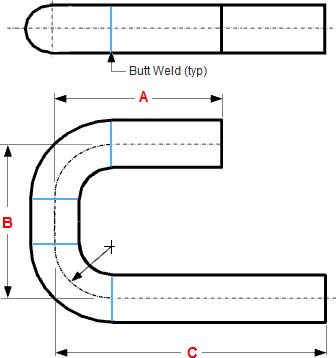
The prototype beneath shows a orthographic view of a barrel welded pipe with iii sizes (A, B, C).
- The A size is measured from the forepart to the center line of the elbow / pipe.
- The B size is measured from centerline to centerline.
- The C size is similar the A size, measured from the front to the middle line of the elbow / pipe.
Orthographic view
(double line presentation)
Isometric view
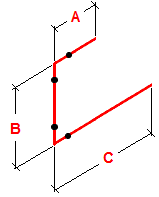
The isometric view shows the same pipe every bit in the orthographic view.
As you tin can see, this drawing is very simple and quick to implement. The cherry-red lines show the pipe, the black dots are the barrel welds and A, B and C are the dimensions of front end to center line and center line to middle line.
The simplicity with which a piping isometric can be drawn is one reason to made iso'southward.
A second reason to fabricated isometrics; if a pipe should exist fatigued in several planes (north to south, and then down and and so to the west, etc.), orthographic views really not an pick. In a orthographic view it is not a problem if the piping runs in i plane, but when a pipe in two or iii planes to exist drawn, a orthographic view can exist unclear.
Another reason why isos are preferred, is the number of drawings that for orthographic views should be made.
For example.. for a circuitous pipeline organisation, 15 isometrics must be fatigued. I've never tried, but I think for orthographic views maybe 50 drawings are needed to show the same as the Iso'due south.
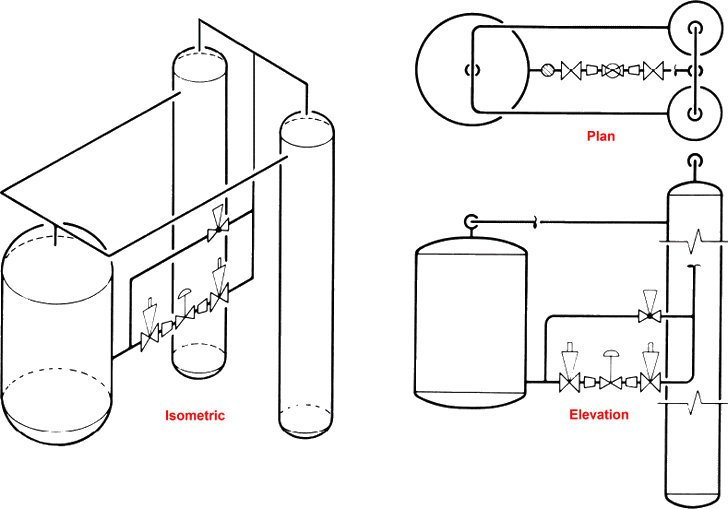
Isometric, Plan and Elevation Presentations of a Piping System
The paradigm beneath testify the presentation used in drafting. The isometric view clearly show the pipage arrangement, but the program view fails to prove the bypass loop and valve, and the supplementary elevation view is needed.
Isometric views in more than than 1 aeroplane
Below are some examples of isometric drawings. The auxiliary lines in the shape of a cube, ensure better visualization of the pipeline routing.
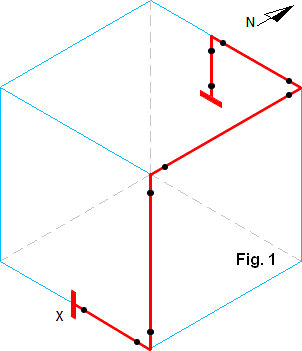
Figure 1 shows a pipeline which runs through 3 planes. The pipe line begins and ends with a flange.
Routing starting indicate X
- pipe runs to the east
- pipe runs up
- pipe runs to the north
- pipe runs to the west
- pipe runs down
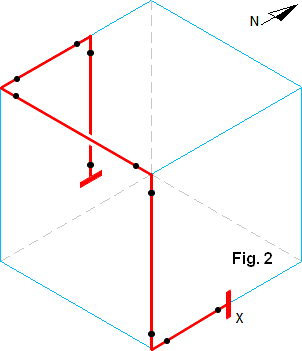
Figure 2 is almost identical to the drawing above. A dissimilar perspective is shown, and the pipe that comes from above is longer.
Because this pipe in isometric view, runs backside the other pipe, this must be indicated past a break in the line.
Routing starting signal Ten
- pipe runs to the south
- piping runs up
- pipe runs to the west
- pipe runs to the north
- piping runs down
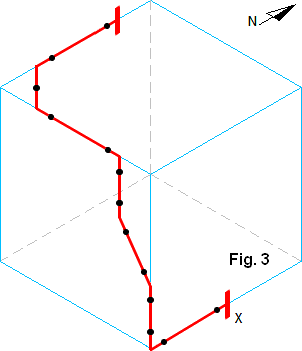
Figure three shows a pipe that runs through three planes and in two planes it make a bow.
Routing starting indicate X
- pipage runs to the south
- piping runs upwards
- pipe runs up and to the w
- pipe runs up
- pipe runs to the west
- pipe runs to the north-due west
- pipe runs to the north
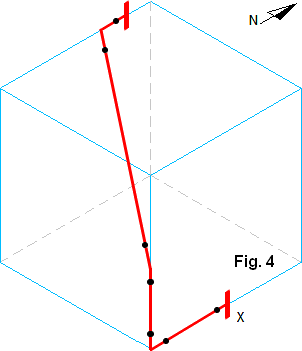
Effigy 4 shows a piping that runs through three planes, from one plane to a opposite plane.
Routing starting point X
- pipe runs to the due south
- pipe runs up
- pipage runs upwards and to the due north-west
- piping runs to the due north
Hatches on a Isometric Cartoon
Hatches on isometric drawings being applied, to indicate that a pipe runs at a certain angle and in which direction the pipe runs.
Sometimes, small-scale changes in the hatch, the routing of a piping is no longer the e, only for example of a sudden to the north.
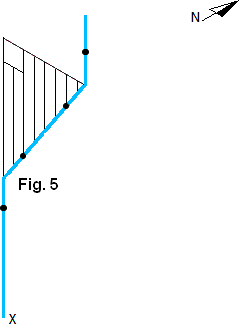
Figure 5 shows a pipage, where the hatch indicates that the heart leg runs to the east.
Routing starting bespeak X
- pipe runs up
- pipage runs up and to the due east
- piping runs upward
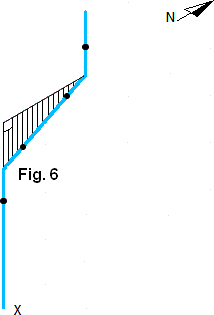
Figure half dozen shows a pipe, where the hatch indicates that the center leg runs to the north.
Routing starting point X
- pipage runs up
- pipe runs up and to the north
- pipe runs upwardly
The two drawings in a higher place show, that changing from simply the hatch, a pipeline receives a unlike direction. Hatches are particularly important in isometric views.
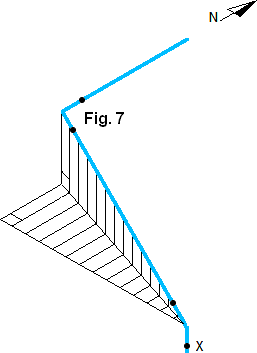
Figure 7 shows a pipe, where the hatches indicates that the middle leg runs up and to the north-west.
Routing starting signal Ten
- pipe runs upwards
- pipe runs up and to the northward-west
- pipe runs to the northward

Source: https://www.wermac.org/documents/isometric.html
Posted by: parkblegame94.blogspot.com
0 Response to "How To Center An Isometric Drawing"
Post a Comment